When we picture Hawaii, our minds usually flood with vibrant technicolor—electric turquoise waves, neon hibiscus blooms, and sun-drenched golden sands. Yet, in his striking fine art photograph, Surf Board Fence Maui Hawaii Black and White, photographer Edward M. Fielding strips away the expected tropical palette, inviting us to see one of Maui’s most beloved roadside oddities through a timeless, monochromatic lens.
Featured in Fielding’s book The Last Resort, this captivating image documents the famous surfboard fence located on Kaupakalua Road in Haiku, Maui. What began in 1990 as a practical measure by local resident Donald “DJ” Dettloff to secure his surfboards against an approaching hurricane quickly evolved into an organic, community-driven art installation. Over the decades, hundreds of discarded, weathered, and donated boards have been wired together, transforming a quiet residential boundary into a towering monument to surf culture.
While most tourists snap colorful selfies in front of the bright, sun-bleached boards, Fielding takes a radically different artistic approach. By rendering the scene in rich black and white, he shifts the focus from kitschy roadside Americana to pure form, texture, and rhythm.
In Fielding’s composition, the pointed tips of the surfboards rise like a picket fence out of dense, lush tropical foliage. Stripped of their bright logos and fading neon paint, the boards take on a sculptural, almost architectural quality. Every scuff, ding, and layer of peeling wax becomes visible, telling the silent story of countless rides on the Pacific swells. The repeating vertical shapes of the boards create a steady visual cadence across the lower third of the frame, mimicking the rhythmic pulse of ocean waves.
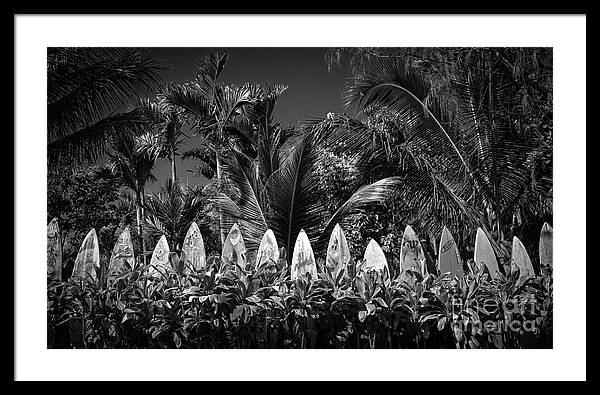
Above the fence, towering palm trees and tropical fronds reach into a dark, dramatic sky. Fielding’s masterful handling of light and shadow gives the foliage a velvety depth, with bright highlights catching the edges of the palm leaves. The contrast between the wild, organic tangle of the Hawaiian jungle and the man-made, geometric repetition of the surfboards creates a compelling visual tension.
There is also a deep sense of nostalgia woven into the monochrome aesthetic. Black-and-white photography naturally evokes memory and history, transforming a modern-day landmark into something that feels like a relic from the golden era of 1960s surfing. Without color to anchor the image in the present day, the viewer is left to contemplate the passage of time, the spirit of aloha, and the beauty found in repurposing discarded objects.
Through Surf Board Fence Maui Hawaii Black and White, Edward M. Fielding proves that sometimes the best way to capture the true soul of a vibrant place is to remove its color. By focusing on light, shadow, and texture, he elevates a quirky Hawaiian fluke into an enduring piece of fine art.